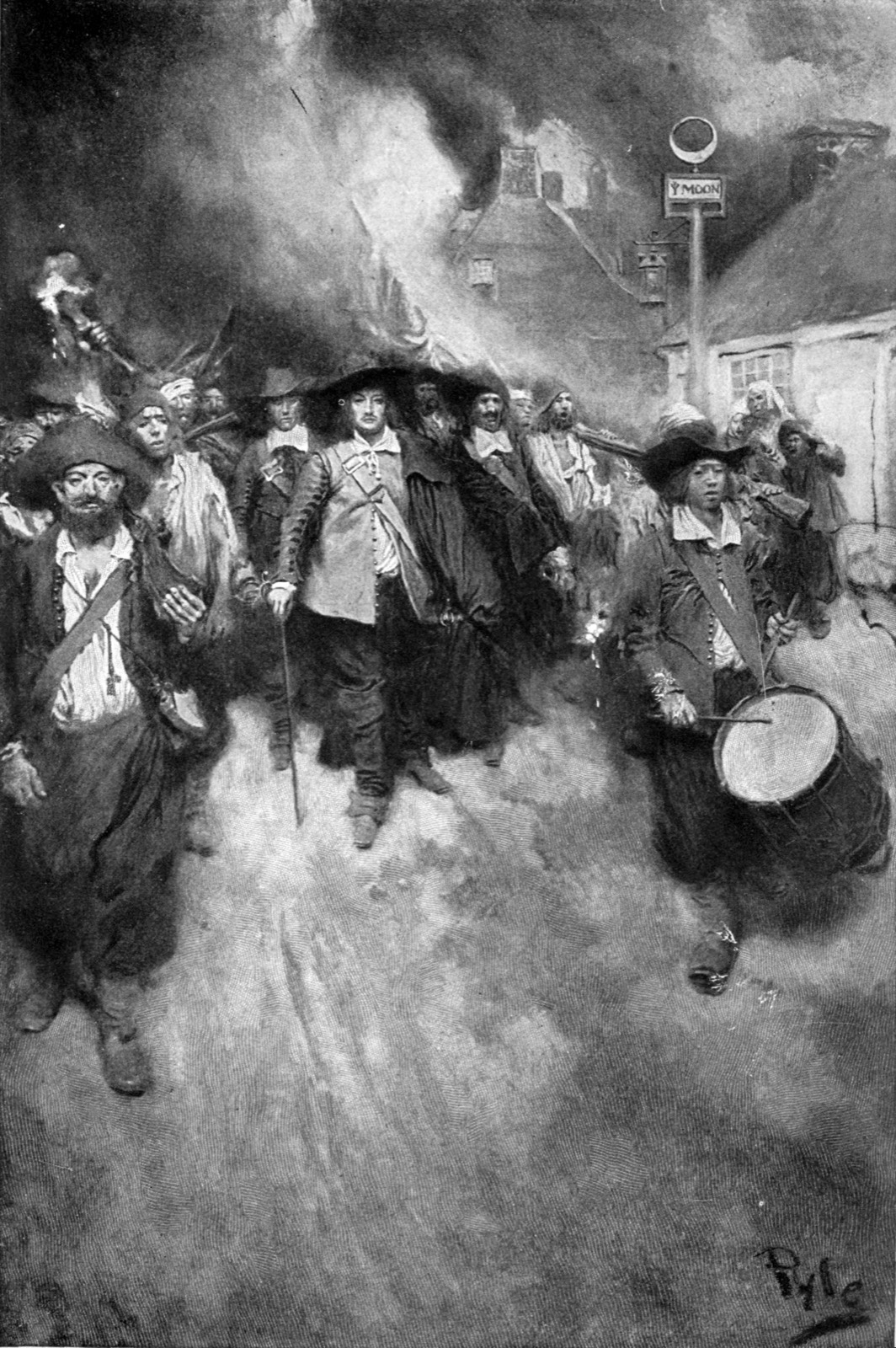
Howard Pyle, The Burning of Jamestown, painted in the early twentieth century. It is a later illustration, not an eyewitness view. Public domain.
In 1676, Virginia’s frontier and Virginia’s elite went to war with each other. Jamestown burned. The labor system that followed was not an accident.
In 1676, Virginia’s frontier and Virginia’s elite went to war with each other. Jamestown burned. The labor system that followed was not an accident.
Nathaniel Bacon was a young, well-connected planter who arrived in Virginia and quickly had a grievance. Governor William Berkeley and the men around him ran the tobacco trade, the Indian diplomacy, and the offices. Frontier settlers wanted war against Native towns and wanted it on their own terms. Berkeley wanted a war he could control, partly because trade with those towns made money for his circle. In the summer of 1676 Bacon marched anyway. In September his men burned Jamestown. Bacon died of dysentery in October. The rebellion folded. Berkeley hanged followers until the Crown told him to stop.
That is the political story. The economic story is why so many white men were angry enough to follow.
By the 1670s the easy river land was claimed. Freed servants who had been promised a farm found the good patents gone, the fees high, and the tobacco price mean. The people at the bottom of white society and the people enslaved at the bottom of the whole society were not allies. They were, for a moment, a shared problem for the men who owned the offices. Bacon’s army included servants and some enslaved people, because a rebellion will take whoever will carry a gun. It was not an emancipation movement. Bacon’s published demands were about Indians, taxes, and the governor’s friends.
Edmund Morgan’s argument, in American Slavery, American Freedom, is that Virginia’s elite learned a lesson: a large class of armed, poor, white former servants was dangerous, and a labor force held in hereditary slavery was easier to isolate. The law over the next generation thickened around that lesson. Poor white men got a small political identity. Black Virginians got a code. Morgan’s book is an interpretation, and historians have argued with it for fifty years. The argument is worth knowing because the dates line up uncomfortably well. Bacon’s Rebellion is 1676. The comprehensive slave code is 1705. In between, the colony rebuilt Jamestown’s authority and tightened the rules of race.
You do not have to believe one rebellion “caused” American slavery. Slavery was already in the colony. You do have to see who was disarmed afterward, and who was armed with a vote just large enough to keep him on the government’s side. The fire destroyed a capital. The settlement that followed sorted the people who would be allowed to burn the next one.
Sources · The royal commissioners’ reports on the rebellion; Bacon’s own declarations; Edmund S. Morgan, American Slavery, American Freedom (1975). For the critique of Morgan, see later work by Anthony S. Parent Jr. and John C. Coombs. The burning of Jamestown was September 1676.