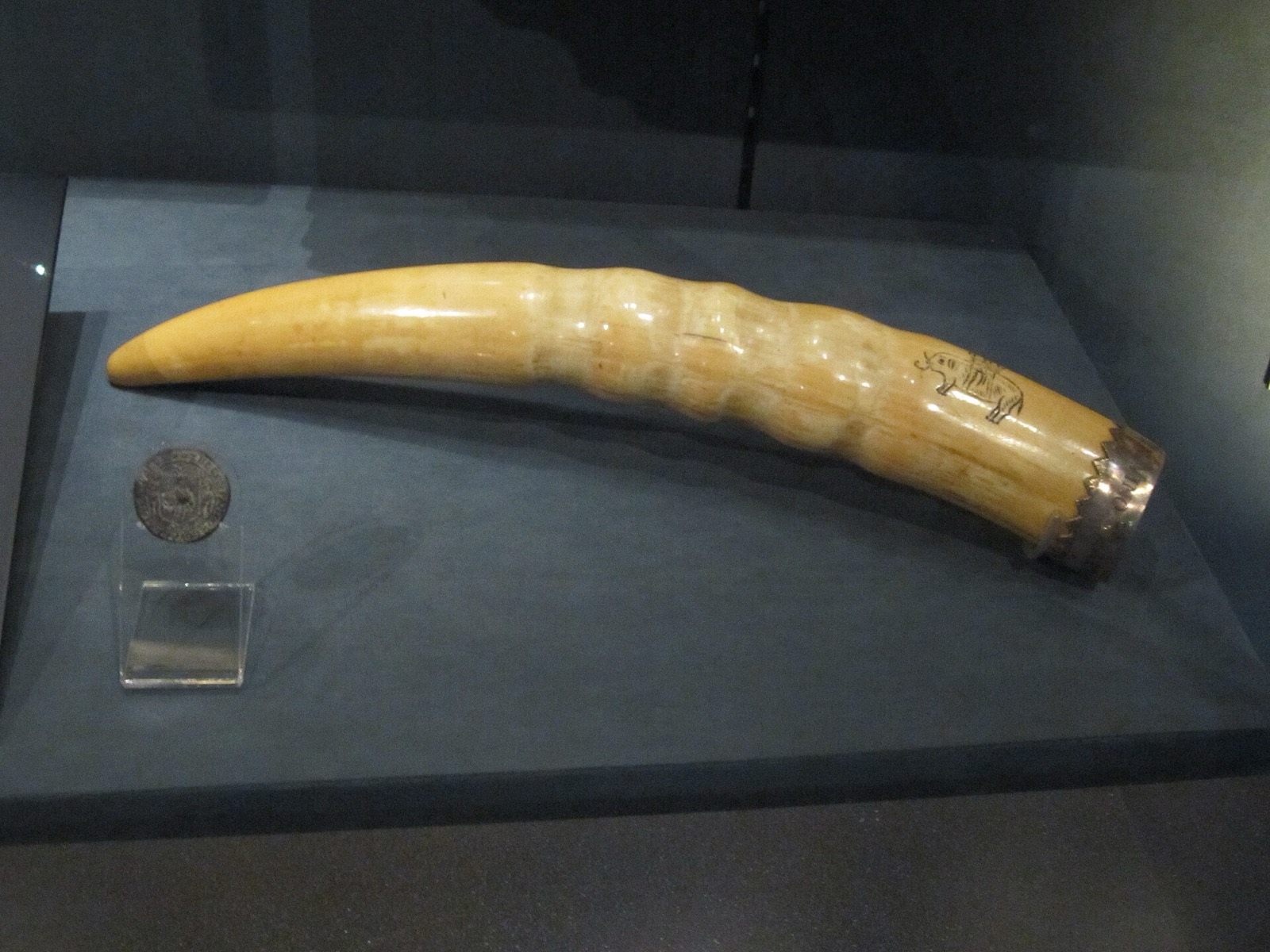
Ivory marked by the Royal African Company, photographed at the International Slavery Museum, Liverpool. The company branded goods the way it branded its business. Wikimedia Commons.
The Royal African Company was a chartered monopoly, with shareholders, a governor, and a license to buy and sell people. When the monopoly cracked, the trade got bigger.
The Royal African Company was a chartered monopoly, with shareholders, a governor, and a license to buy and sell people. When the monopoly cracked, the trade got bigger.
In 1672 Charles II chartered the Royal African Company. Its governor was his brother, the Duke of York, later King James II. The company received a monopoly on English trade with the West African coast. Gold, ivory, and dye woods were in the charter. So were human beings. This was not a secret sideline. Enslaved people were a listed cargo.
Calling it an IPO uses a modern word for a seventeenth-century thing. There was no stock exchange filing and no prospectus in the later sense. There was a joint-stock charter. Merchants and courtiers subscribed capital. They owned shares. They expected dividends from a trade the Crown had closed to everyone else. If you want the honest translation: it was a publicly subscribed company whose business was monopoly, and whose monopoly included the slave trade. “The first slave-trade IPO” is a headline. The charter is the fact.
A monopoly is a license to be the only seller, or here the only English buyer and carrier. The company maintained forts on the African coast, the famous one being Cape Coast. Forts cost money. Monopolists said the forts justified the exclusive right: someone had to pay for the infrastructure, so someone had to keep the profits. Independent merchants said the company was slow, expensive, and not delivering enough labor to the sugar islands. Planters in Barbados and Jamaica agreed with the independents. They wanted more people, cheaper. Read that sentence again. The complaint against the monopoly was not that it shipped human beings. The complaint was that it did not ship enough of them.
In 1698 Parliament opened the English slave trade to other merchants, who paid a duty to help maintain the company’s forts. The company’s exclusive grip ended. The volume of the trade rose. Historians argue about the exact multiple, and this piece will not invent one. The direction is not controversial. Competition did what competition often does. It increased supply. In this market, supply meant voyages.
The Royal African Company lingered, shrank, and eventually lost the trade that had justified it. The trade did not shrink with the company. It moved into more hands. A monopoly can be evil and still be the smaller version of the evil. Opening the market made the market worse because the market was the sale of people. That is the fact the word “deregulation” is too small to hold, and too useful to avoid.
Sources · The 1672 charter; K.G. Davies, The Royal African Company (1957); William A. Pettigrew, Freedom’s Debt: The Royal African Company and the Politics of the Atlantic Slave Trade, 1672–1752 (2013). The 1698 opening of the trade is the Act that ended the exclusive privilege.