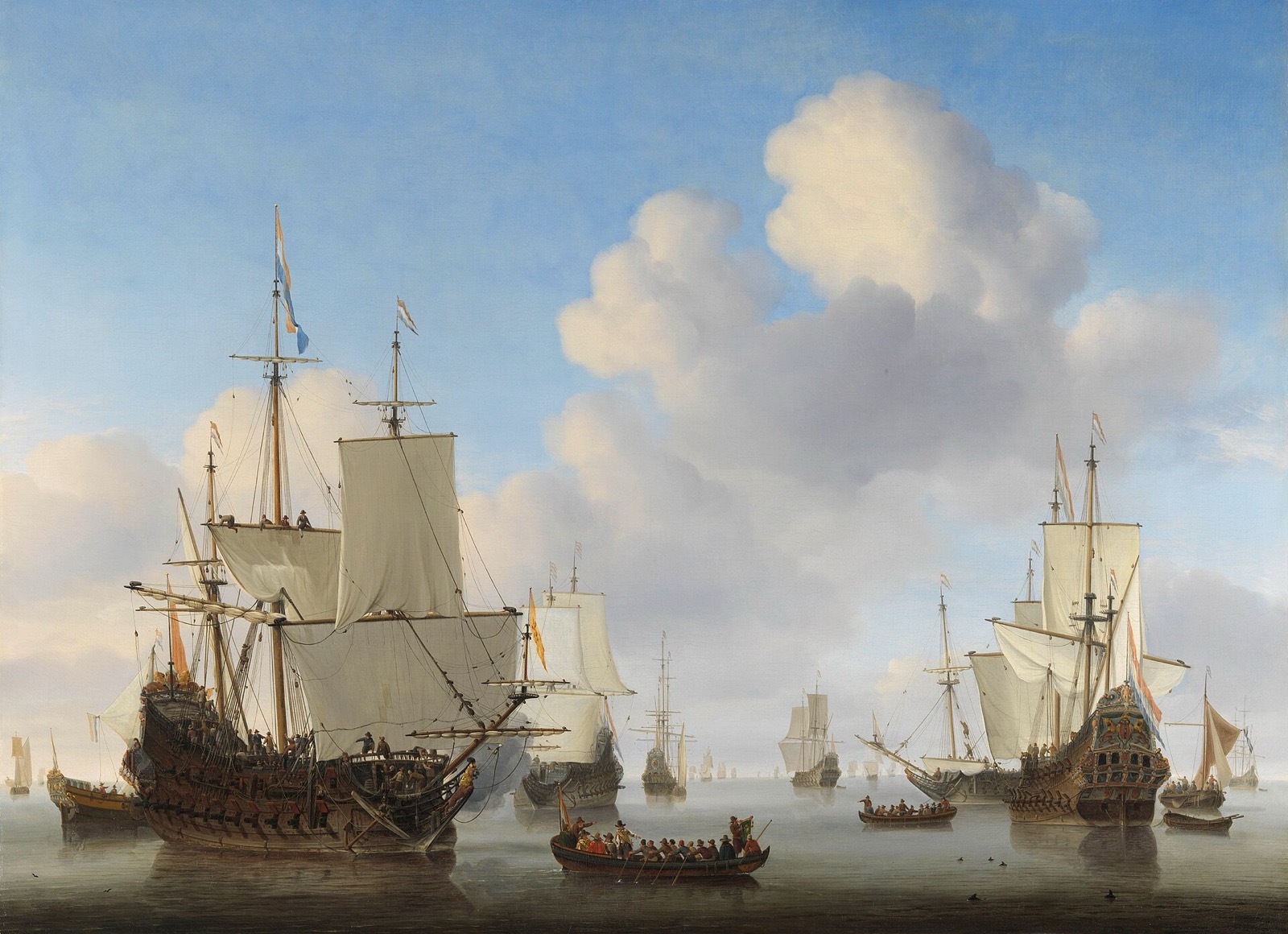
Willem van de Velde the Younger, Dutch men-of-war and merchant ships. The molasses trade moved on hulls like these, legal and otherwise. Public domain.
The Molasses Act of 1733 put a heavy tax on foreign molasses and almost nobody paid it. The crisis came thirty years later, when Britain cut the tax and started collecting.
The Molasses Act of 1733 put a heavy tax on foreign molasses and almost nobody paid it. The crisis came thirty years later, when Britain cut the tax and started collecting.
In 1733 Parliament laid a duty of six pence a gallon on molasses imported to the colonies from foreign islands. Six pence was high enough, relative to the price, to make French molasses unprofitable if anyone paid. The intended beneficiaries were British sugar planters, especially in the Leeward Islands and Jamaica, who did not want New England buying from their French rivals. The intended payers were the distillers and merchants of Rhode Island, Massachusetts, and New York.
Almost nobody paid. Six pence was not a price. It was a suggestion the ports declined. The trade went on, the rum went on, and the Act sat on the books as proof that a parliament could be ignored if it was far away and the jury was local. For a generation, that was the whole story. A bad law, evaded, and therefore strangely stable.
After the Seven Years’ War, Britain was in debt and done looking away. George Grenville’s Sugar Act of 1764 cut the molasses duty to three pence and then, in practice and in later revision, toward a rate people might actually pay. It also changed the court. Smuggling cases could go to vice-admiralty courts, without a colonial jury. A lower tax, collected, costs more than a higher tax nobody pays. New England understood the arithmetic immediately.
This is the part the headline gets wrong if the headline stops in 1733. The Molasses Act did not start the Revolution. It taught merchants that trade law was negotiable. The Sugar Act taught them that Britain had stopped negotiating. The rights language came fast, because the money was already on the table. “No taxation without representation” is a constitutional sentence. It was first a customs dispute about a gallon of molasses.
Read the coalition. British planters wanted a protected market. London wanted revenue and a rule that looked like a rule. Colonial distillers wanted cheap feedstock. Enslaved people on the sugar islands produced the molasses and did not appear in the petition. Any account that makes this a clean story about American freedom is leaving out the people who made the sugar. The protest was real. The product was not innocent. Both belong in the same paragraph, or the paragraph is advertising.
WallPost’s rule on this Act is the rule on the whole edition. Name the rate. Name who wrote it. Name who dodged it. Name who was never in the room. Six pence. Then three pence. Then a war. The gallon was small. The system it was attached to was not.
Sources · The Molasses Act, 6 Geo. II c. 13 (1733); the Sugar Act of 1764; Andrew Jackson O’Shaughnessy, An Empire Divided: The American Revolution and the British Caribbean (2000), on the planters who wanted the duty; John W. Tyler, Smugglers and Patriots (1986).