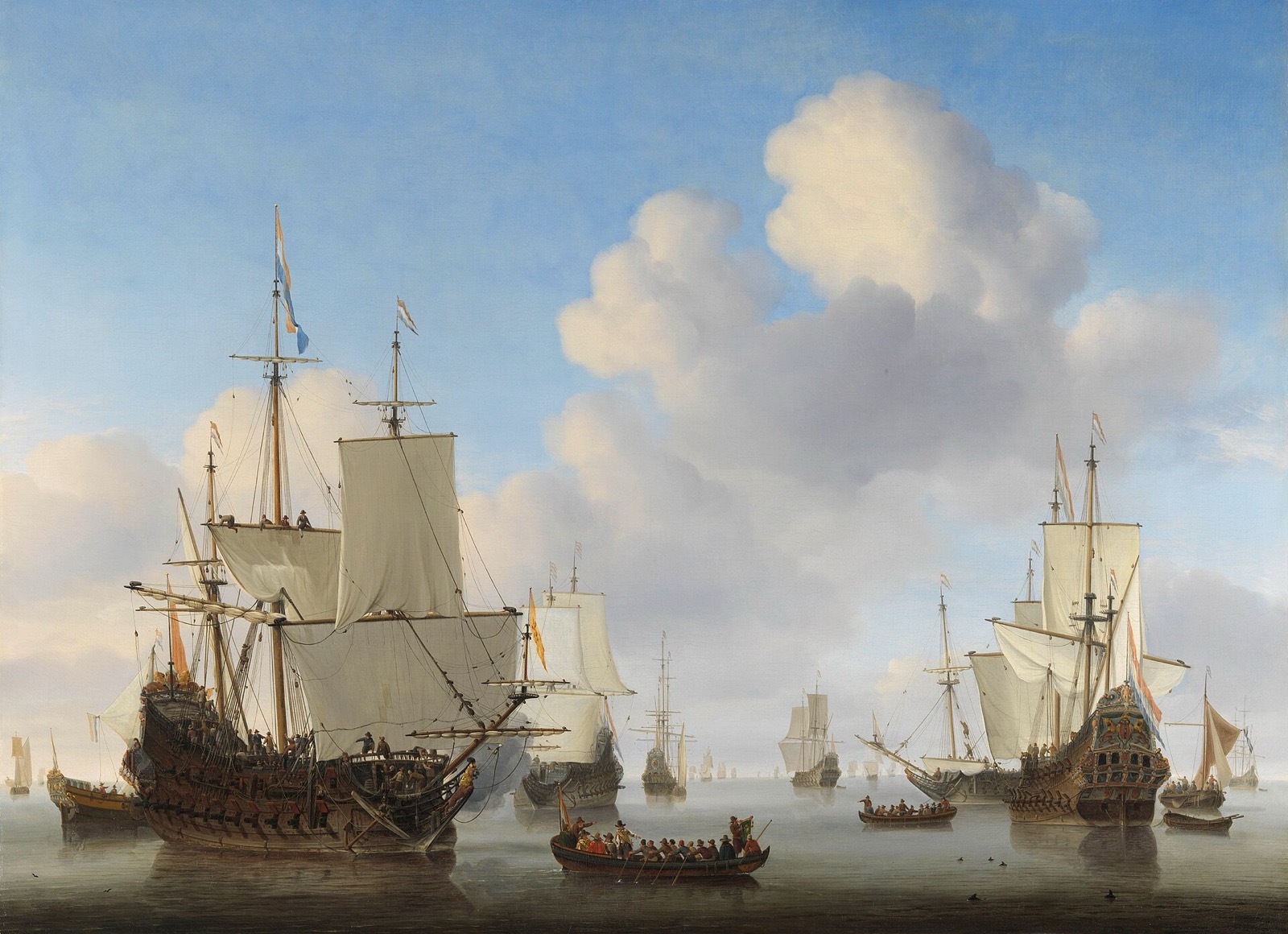
Willem van de Velde the Younger, Dutch shipping in a calm. Foreign hulls in colonial waters were exactly what London’s trade laws were written to stop. Public domain.
When legal trade was forced through England, colonial merchants built a second trade beside it. By 1700 that second trade was a business, not an exception.
When legal trade was forced through England, colonial merchants built a second trade beside it. By 1700 that second trade was a business, not an exception.
Smuggling sounds like a man with a rowboat. In the colonial economy it was closer to a wholesale business with friends in the customs house. The Navigation Acts said enumerated goods went to England, and European goods came out from England. Molasses from the French Caribbean, tea from the Dutch, cloth that had not paid the English markup: all of it moved anyway, because the legal route was designed to be the expensive route. The expensive route is a business opportunity for anyone willing to skip it.
A merchant in Newport, Boston, or New York did not think of himself as a criminal class. He thought of himself as a man avoiding a clumsy duty. Juries in colonial ports would not convict him. Judges who tried lost their popularity and sometimes their windows. Customs officers were offered a share of seized cargo, which made them interested, and then offered a bribe, which made many of them reasonable. The law assumed a state that could watch a coastline. The coastline was longer than the state.
The good that mattered most, by the middle of the eighteenth century, was molasses. New England distilled it into rum. Rum bought more than drinks. It was a trade good on the African coast and a ration in the fisheries. French islands produced molasses more cheaply than the British sugar islands, because French planters were told to send the best sugar home and had molasses left over. British planters wanted that molasses kept out. New England wanted it let in. London had to choose which subjects to disappoint. It tried, in 1733, to disappoint New England. New England kept buying.
A population that spends fifty years treating a trade law as optional will not accept a sudden crackdown as justice. It will call it tyranny, and it will be talking about its margins as much as its rights. That does not make the smuggler a founder of liberty. It makes him a person whose business model was the gap in the empire. When Britain tried to close the gap after the Seven Years’ War, to help pay for the war, it turned a commercial habit into a constitutional fight. The habit came first.
Sources · Customs reports and the complaints of British sugar planters in the 1730s; John W. Tyler, Smugglers and Patriots: Boston Merchants and the Advent of the American Revolution (1986); the Molasses Act of 1733, which is the subject of the next article, is the law this trade was built to dodge.