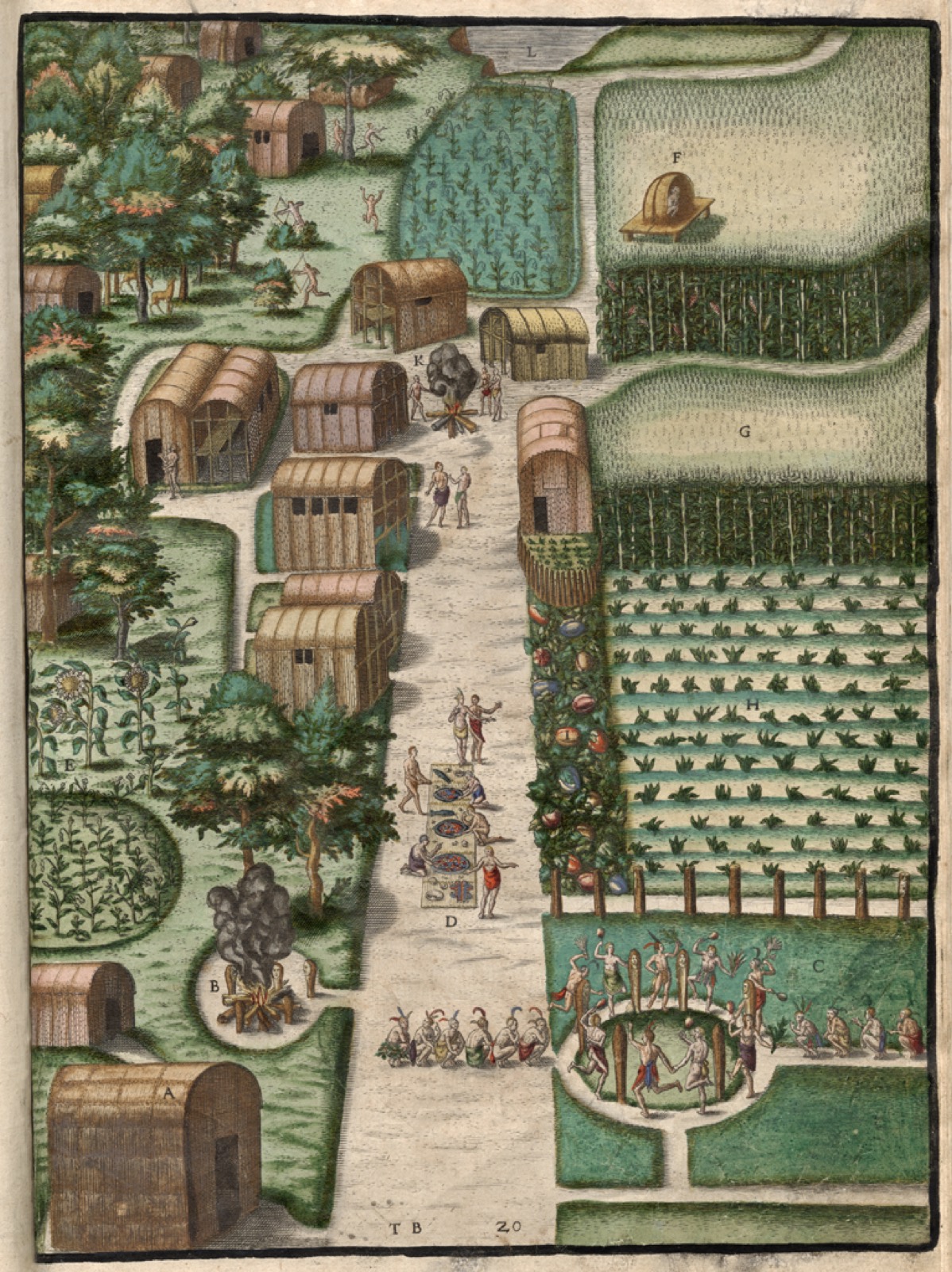
Theodor de Bry, engraving of Secoton, published in 1590 from John White’s watercolors of the Carolina coast. It is not a picture of the winter of 1609. It is the country the colony had entered. Public domain.
In the winter of 1609, the Virginia Company’s colony collapsed inside its own fort. About sixty people walked out. The company kept raising money.
In the winter of 1609, the Virginia Company’s colony collapsed inside its own fort. About sixty people walked out. The company kept raising money.
The winter of 1609 to 1610 is called the Starving Time because that is what it was. It was also a corporate failure, and the two facts are the same fact.
By the autumn of 1609, several hundred colonists were inside the Jamestown fort. A relief fleet had brought more people than the settlement could feed. John Smith, who had imposed some order, was gone, injured and sent back to England. The ships that were supposed to follow, including the colony’s new leaders, wrecked in a hurricane. One of them, the Sea Venture, sat on a reef in Bermuda. Jamestown went into winter without the supplies those ships were carrying.
George Percy, who presided over the fort, later wrote that of about five hundred people, roughly sixty were still alive when help came in May 1610. That is Percy’s number, written by a man who was there. It is the number this account uses. Disease, bad water, and hunger did the killing. So did the decision to put more bodies into a place that could not feed the bodies already there.
In 2012 and 2013, archaeologists led by William Kelso at Jamestown reported cut marks on the skull of a girl of about fourteen. They called her Jane, because her name is not in the records. The marks are consistent with cannibalism after death. The colony’s own writers had said people ate the dead. The archaeology stopped that from being dismissed as rumor.
Jane is not a metaphor. She is evidence that the shortage was absolute. She is also evidence of what the company’s papers did not treat as worth naming. The ledger in London tracked investors. It did not track her.
Sir Thomas Gates reached Jamestown in May 1610, after months in Bermuda, and found a ruin. He decided to abandon the colony. The survivors boarded ships and started down the James River. At the mouth of the river they met a new fleet under Lord De La Warr, with more settlers and more supplies. The abandonment was reversed. The company would get another chance. The dead would not.
What followed was not a gentler regime. Gates and Sir Thomas Dale imposed the Laws Divine, Moral and Martial, a military code. Leaving the colony, stealing food, and speaking against the government could be punished by death. The code was published in London in 1612. It is a primary source. It shows how a failing investment was held together: not by a harvest, but by force.
The people inside the fort paid with their lives. The Powhatan communities around the river paid next. A hungry garrison takes food. Raids replaced trade. A war followed, and it was not a war those towns had asked for.
Investors paid last, and in a different currency. The Virginia Company did not close its books in 1610. It told a better story in London and asked for more capital. The share was a claim on land and profit across an ocean. The person who held it did not see the fort. That distance is the whole mechanism. Information traveled slowly, and the people who needed the optimistic version were the ones writing the pamphlets.
Nothing about this requires a modern slogan. A company put more people into a failing settlement than the settlement could feed, punished those who tried to leave, and went back to the market for money. The winter is the evidence.
Sources · George Percy’s account of the winter of 1609–1610; William Strachey and the wreck of the Sea Venture; For the Colony in Virginea Britannia. Lawes Divine, Morall and Martiall (London, 1612); William M. Kelso, Jamestown, the Buried Truth (2006), and the Jamestown Rediscovery report on “Jane” (2013).