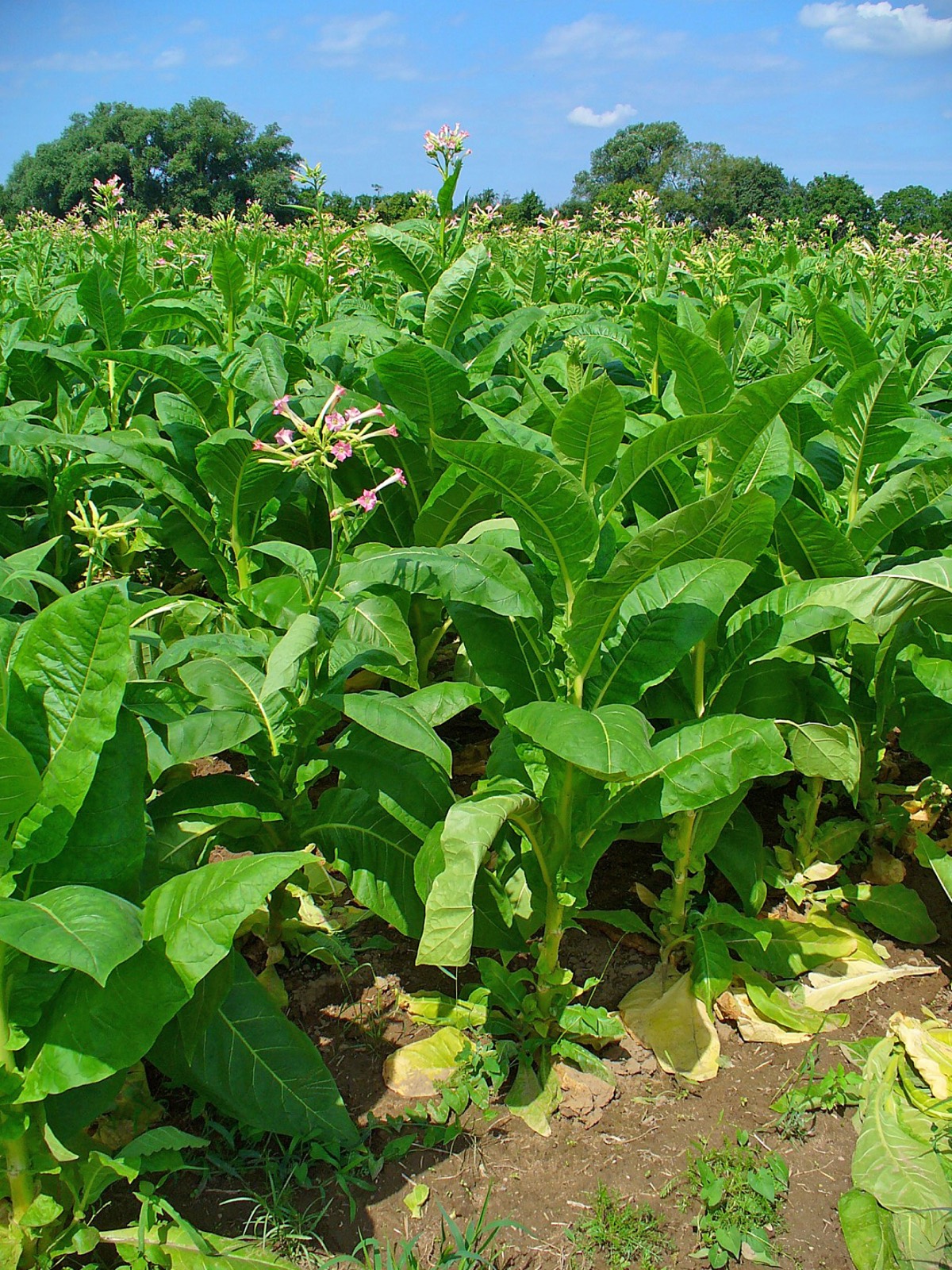
Nicotiana tabacum. Public-domain photograph. The plant is the commodity. It is not a portrait of Rolfe’s field.
John Rolfe planted a tobacco the English market would actually buy. The story of a single theft under a death sentence is mostly legend. The boom that followed was not.
John Rolfe planted a tobacco the English market would actually buy. The story of a single theft under a death sentence is mostly legend. The boom that followed was not.
Around 1612, John Rolfe harvested a kind of tobacco Virginians had not been able to sell. The leaf the English already smoked came from the Spanish Caribbean, especially Trinidad and the Orinoco. It was sweeter than the harsher plant Native growers already knew. Rolfe, who had survived the Sea Venture wreck and married Pocahontas, tried the West Indian leaf in Virginia soil. By 1614 he had a crop London would buy.
That is the documented part. The popular version adds a scene the records do not support: a spy, a stolen pouch of seed, and a Spanish death penalty waiting on the dock. Spain did forbid foreigners from taking tobacco seed out of its colonies. That law was real. A specific heist, with a named thief and a shipment that can be traced, is not in the company records. WallPost will not print the legend as if it were a fact.
Before Rolfe, Jamestown had no reliable export. The company had promised gold, a passage to Asia, and quick returns. It had a swamp and a death rate. Tobacco was the first product that turned the colony into a business someone in London could understand. You could weigh it, ship it, and sell it.
The quantities start small and then do not stay small. A few hundred pounds in the mid-1610s became hundreds of thousands of pounds by the late 1620s, and millions later in the century. The exact early totals vary by historian because the company’s papers are incomplete. The direction does not vary. Tobacco saved the investment. Then it captured it.
A crop that sells crowds out a crop that only feeds. Colonists planted tobacco in streets and yards. Food had to be imported, or taken. The company, which still could not pay a cash dividend, began paying investors in land instead. Land without labor was worthless, so the company and the planters imported labor: first indentured servants, later enslaved Africans. The first recorded Africans arrived at Point Comfort in 1619, on an English privateer that had taken them from a Portuguese slave ship. They were not the beginning of the tobacco economy. They entered an economy that already needed hands.
The seed, stolen or not, is the wrong mystery. The mystery that matters is how a luxury leaf became the reason Virginia existed, and who was brought in to grow it once the leaf had a price.
Sources · Rolfe’s own letters and the company’s export talk in the 1610s, collected in Susan Myra Kingsbury’s Records of the Virginia Company; Edmund S. Morgan, American Slavery, American Freedom (1975), on the turn to tobacco. The Spanish ban on exporting seed is attested in imperial commercial law; a specific theft by Rolfe is not.