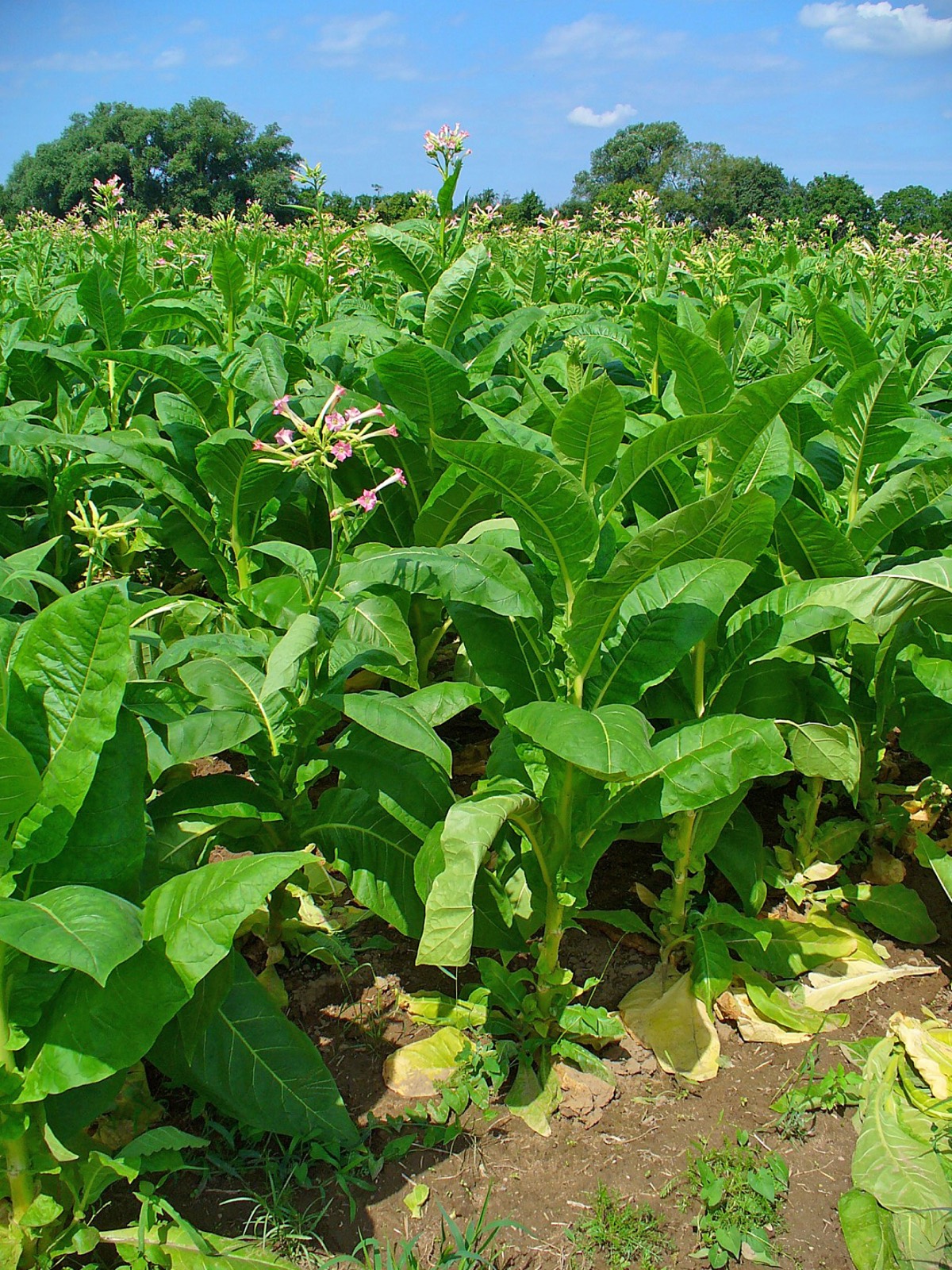
Nicotiana tabacum. Public domain. The plant is a heavy feeder. The colony treated that as a land policy.
Tobacco did not just tire the soil. Worn-out fields became the reason to take the next tract, and then the one after that.
Tobacco did not just tire the soil. Worn-out fields became the reason to take the next tract, and then the one after that.
Tobacco pulls nitrogen and potassium out of the soil faster than a careful rotation puts them back. Seventeenth-century planters did not have that sentence. They had the result. A field that produced a heavy leaf for a few years produced a thin one after that. The remedy they trusted was not fertilizer. It was a new field.
That habit has a name in later economics: extensive growth. You get more output by using more land, not by getting more from the same land. It feels like prosperity. The plantation gets larger. The colony’s map fills in. What it really means is that the business model includes abandonment. Yesterday’s field is this year’s pasture, or waste, and the valuable thing has moved.
The 1618 headright paid planters in acres for importing people. If your old acres were tiring, the rational move was to claim new ones and move the people. The people, increasingly, were held for life. Soil mining and human bondage grew up as one system. You cannot separate “agricultural practice” from “labor system” in this economy. The leaf determined both.
By the 1630s the pattern was visible along the James, the York, and the Rappahannock. Plantations sat on the rivers because the rivers were the roads. Ships took the leaf to England and brought back cloth, tools, and credit. A planter who wanted a new tract wanted a river front first. Native towns were in the way of that map. The wars of the 1620s, 1640s, and 1670s were about a great many things. One of them was that tobacco kept needing a next field.
It is not a claim that every planter understood a nutrient cycle and chose conquest in a boardroom. It is a claim about incentives. A crop that exhausts land, a law that rewards importing labor with more land, and a market that pays for the leaf and not for the soil, will expand. Nobody in the system had to be a villain in his own diary for the map to move. The diary often says improvement. The map says dispossession.
Later agricultural reform, from crop rotation to guano to manufactured fertilizer, is the attempt to escape this trap. Colonial Virginia did not escape it. Virginia grew by leaving used-up ground behind.
Sources · Contemporary complaints about thin yields and abandoned fields are scattered through county records and travelers’ accounts; Avery Odelle Craven, Soil Exhaustion as a Factor in the Agricultural History of Virginia and Maryland, 1606–1860 (1926), is the classic study. The headright is in the company and colonial land patents from 1618 onward.