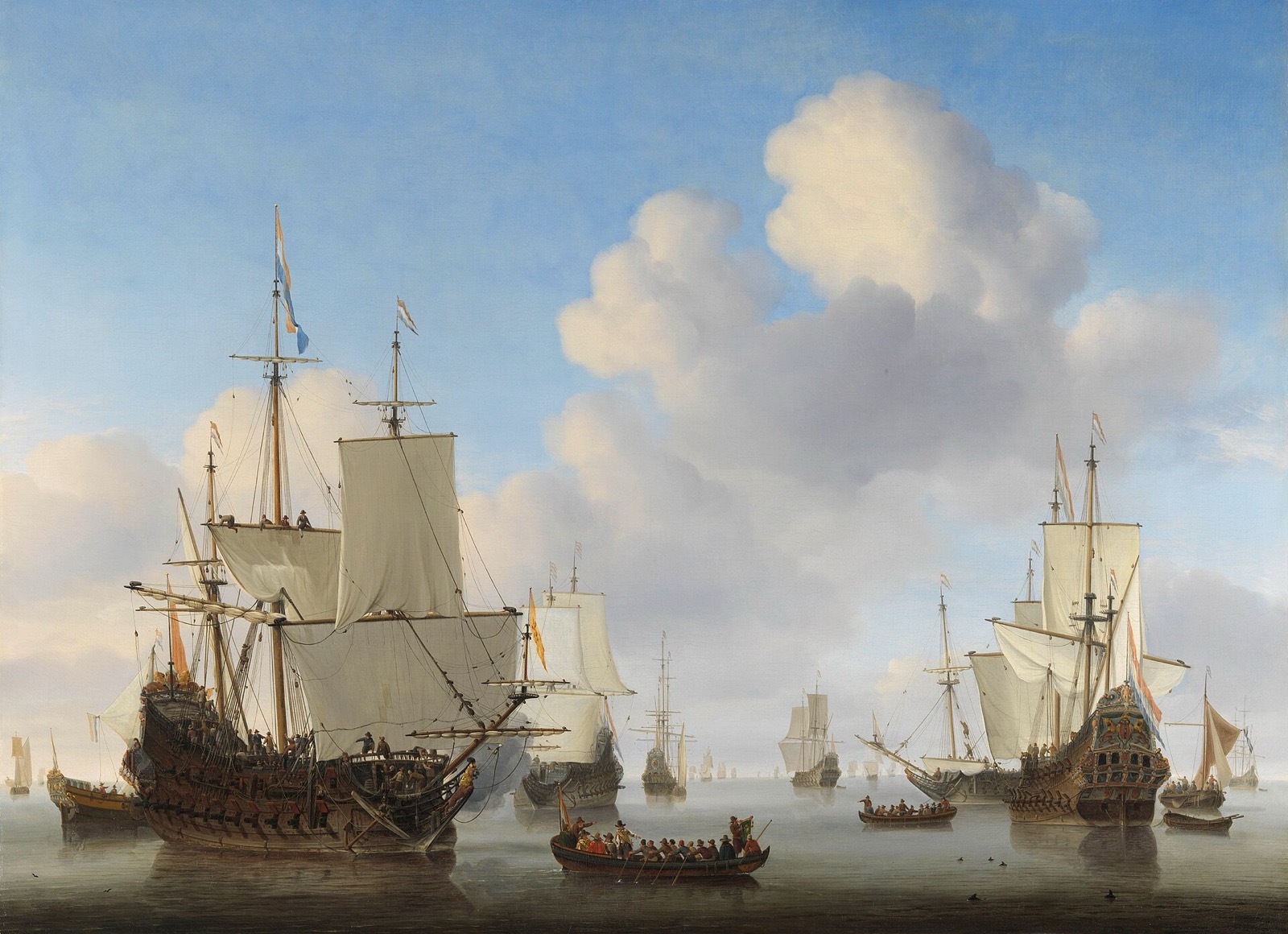
Willem van de Velde the Younger, Dutch men-of-war and other shipping in a calm. The Navigation Acts were written to push Dutch carriers out of English colonial trade. Public domain.
England wrote the Navigation Acts to keep colonial trade inside English ships and English ports. The colonies learned to trade around the law.
England wrote the Navigation Acts to keep colonial trade inside English ships and English ports. The colonies learned to trade around the law.
The first Navigation Act, in 1651, was aimed at the Dutch. They were better carriers than the English, and they were everywhere in the Atlantic. The Act said that goods coming into England and its possessions had to travel in English ships, or in ships of the country that produced the goods. The Restoration Parliament rewrote and extended the system in 1660, 1663, and after. Certain colonial products — tobacco, sugar, cotton, indigo, and later rice and others — were “enumerated.” They had to be shipped to England or an English colony before they could go anywhere else, and they had to go in English or colonial ships.
The theory was mercantilism in one paragraph. The wealth of the kingdom is the trade of the kingdom. Trade in foreign hulls is wealth leaking out. Colonies exist to supply the center and to buy from the center. The Staple Act of 1663 closed the other door: most European goods headed for the colonies had to pass through England first. London took a cut on the way out and on the way in.
For decades, enforcement was thin. The ocean is large, customs officers were few, and a colonial governor who annoyed every merchant in his port did not last. Planters needed markets. Ship captains needed cargoes. Dutch, French, and colonial hulls kept loading where the price was better than the law. The Acts created a legal trade and, beside it, a normal illegal one. Smuggling in the eighteenth century was not a romance. It was how the enumerated list met a real demand.
The Acts also did something London intended and then lived to regret. They built an English merchant marine and a colonial one. New England learned to carry other people’s freight, to distill Caribbean molasses, and to sell to everyone. Those skills were useful to the empire right up until they were useful against it. A shipping industry is a navy in civilian clothes. When the break came, the colonies were not commercially helpless. The monopoly had trained its own competitors.
The serious break was not 1651. It was the decision, after 1763, to enforce what had been negotiable. A law people have ignored for a century becomes a crisis when someone suddenly collects it. The Sugar Act, the stamp taxes, and the customs seizures were that crisis. The Navigation Acts did not start the Revolution by themselves. They built the argument the Revolution used: that a trade run for the center, and tightened without consent, was a tax whether or not the paperwork said tax.
Sources · The Navigation Act of 1651 and the Acts of 1660 and 1663; Lawrence A. Harper, The English Navigation Laws (1939); the enumerated list is the primary text. Oliver M. Dickerson, The Navigation Acts and the American Revolution (1951), argues the system was bearable until enforcement changed.